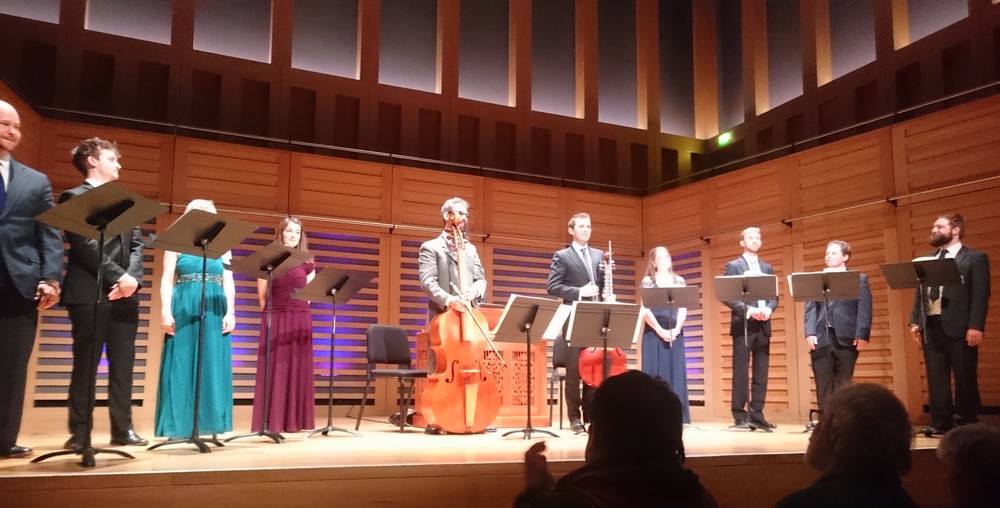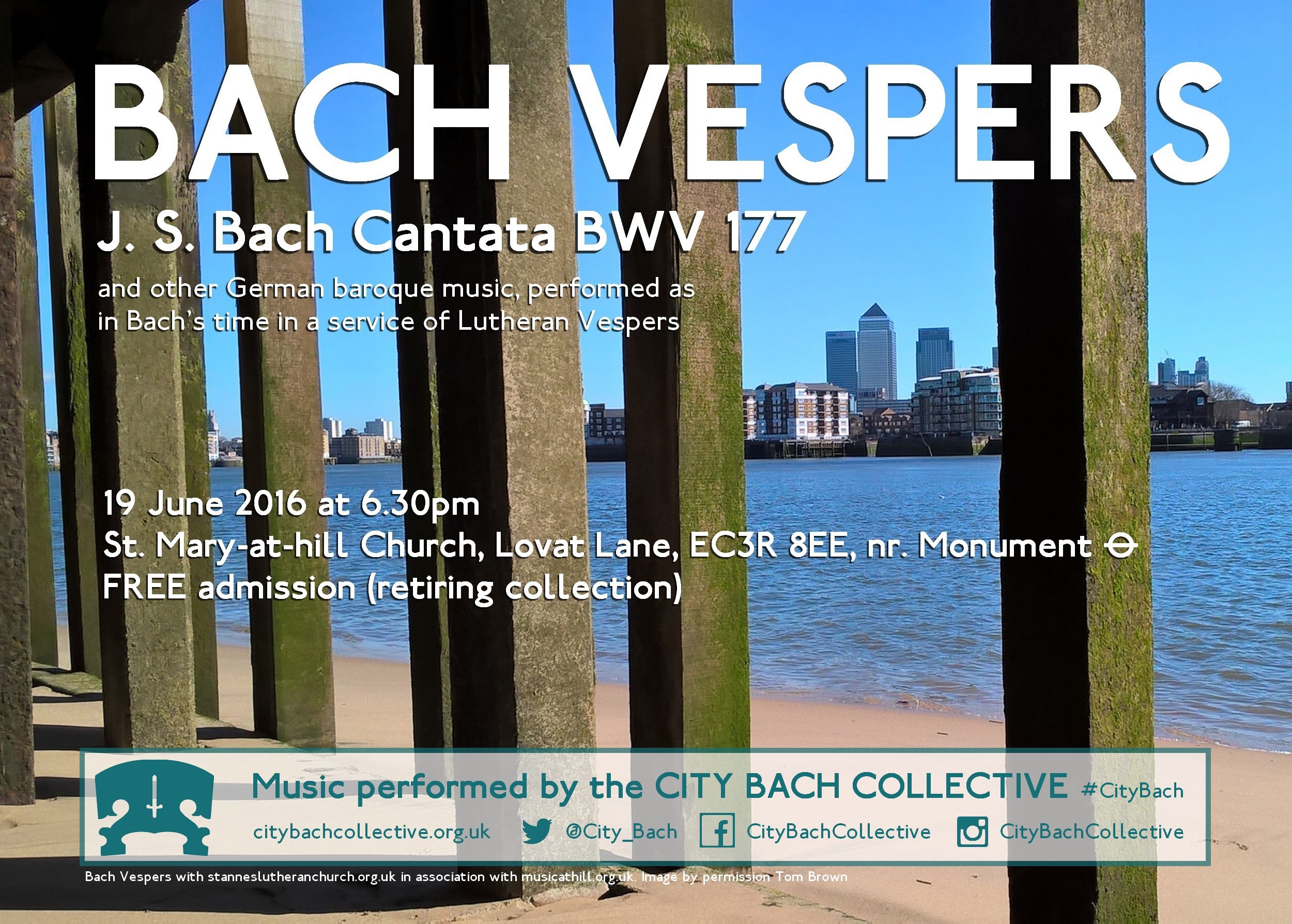
Bach Vespers, St. Mary-at-Hill, 19 June 2016

city bach collective

We are very pleased that once again St. Anne’s Lutheran Church have invited us to perform the music at Bach Vespers on 19 June. This Sunday is the fourth after Trinity for which Bach wrote the cantata ‘Ich ruf zu dir, Herr jesu Christ’, BWV 177, in Leipzig in 1732.

At the centre of the cantata is the chorale melody of the title. This is piece of music made famous in modern cinema. Bach’s own chorale prelude BWV 639 was used by Andrei Tarkovsky in his 1972 masterpiece Solaris (featuring the use of Peter Breugel the Elder’s Hunters in the Snow, below) and Michael Haneke used a piano transcription of the same for his 2012 Palme d’Or-winning film Amour.

city bach collective

We will perform the chorale prelude at this service. In addition we’ll perform music by Andreas Raselius, Heinrich Schütz, Franz Tunder and Michael Nicolai. We are delighted to hear that the Bishop of the Lutheran Church in Great Britain, the Rt. Rev’d Dr. Martin Lind will preach at this service.

This service of Lutheran Vespers is free to attend at St. Mary-at-hill, Lovat Lane, EC3R 8EE at 6.30pm. More on what happens at the service here.
Nikolaus Harnoncourt, 1929 – 2016

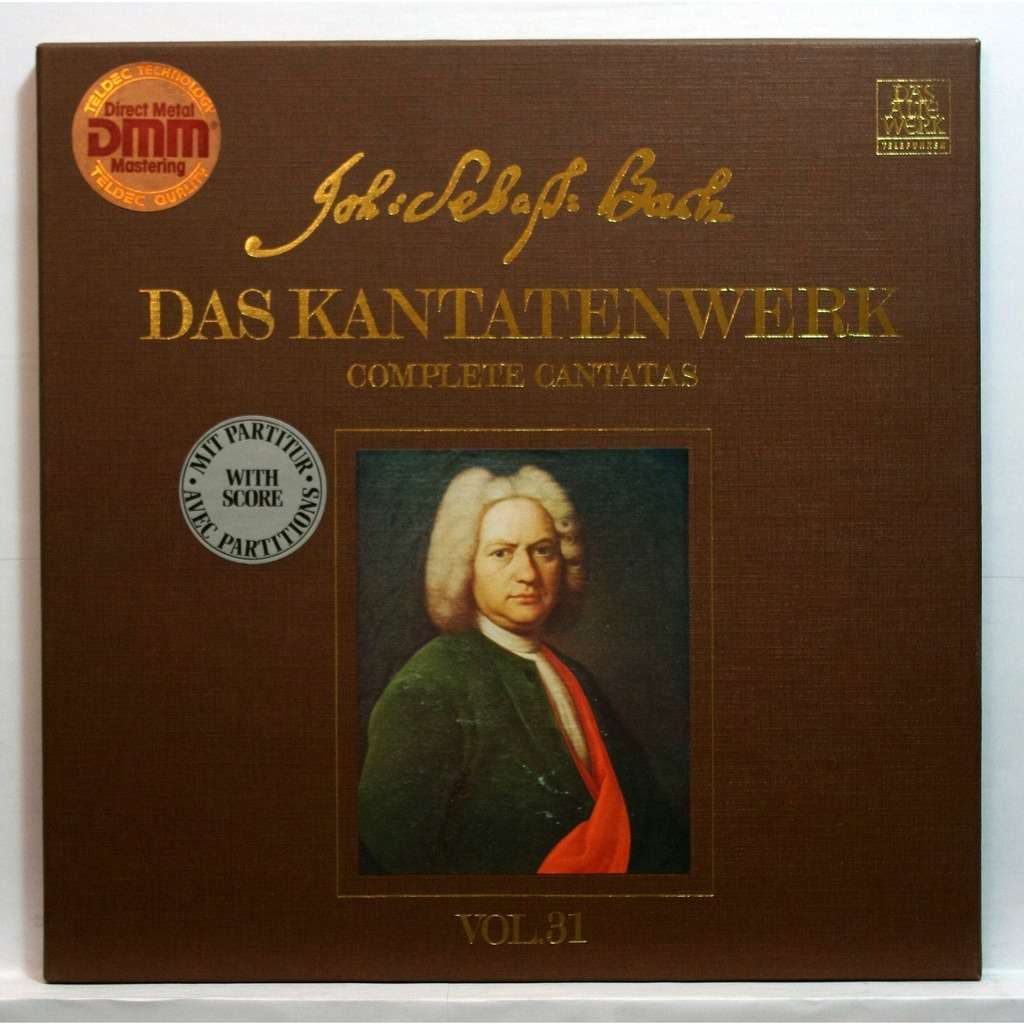
Teldec’s original packaging with J.J. Ihle’s portrait of Bach

News of the death of Austrian conductor and period performance pioneer Nikolaus Harnoncourt is a chill wind to those of us involved with the City Bach Collective.

Harnoncourt was a leading figure in the period performance movement, setting up Concentus Musicus Wien in 1953. Moreover, in 1971 he, with his colleague Gustav Leonhardt (who died in 2012) and their respective groups, undertook to record all J.S. Bach’s church cantatas for the Teldec label. This they achieved in 1990, the first complete period-instrument survey. You can listen to them all via this YouTube playlist. (Our concerts of Bach cantatas in the City and subsequent performance of Bach’s cantatas in Lutheran Vespers – the Bach Vespers series – ran for a similar period in the slipstream of this, from 1976 to the first cycle completion in 1997.)

The familiar brown covers of the records of this series have been a constant companion for those of us who have taken an interest in Bach’s cantatas in any depth. With considerable scholarship and an uncompromising pursuit of something truly novel (using all male voices almost entirely throughout, including solo boy trebles) the music-making captured can occasionally sound rather exotic. In a lengthy review for the NY Times from 1991, the American musicologist Richard Taruskin makes a case for this being the true intent of Harnoncourt and, to a lesser extent, Leonhardt – to reveal the Boschian nightmare of Luther’s vision of hell-on-earth through music not only of great beauty but also impossible cacophony.

While this extreme view has little traction here, Harnoncourt’s forcing wide the envelope of possibility has allowed our imaginations to run free in trying this great wealth of music for ourselves. The recordings came with a great deal of supplementary material, including sheet music, facilitating the diving-off point for proper investigation. Our tradition of performing the cantatas within the liturgy continues on 24 April with cantata BWV 166, ‘Wo gehest du hin?’. We will try to triangulate our love for performing this fine music with its inseparable liturgical purpose, remembering the living platform that Harnoncourt’s work in this and all music has provided.

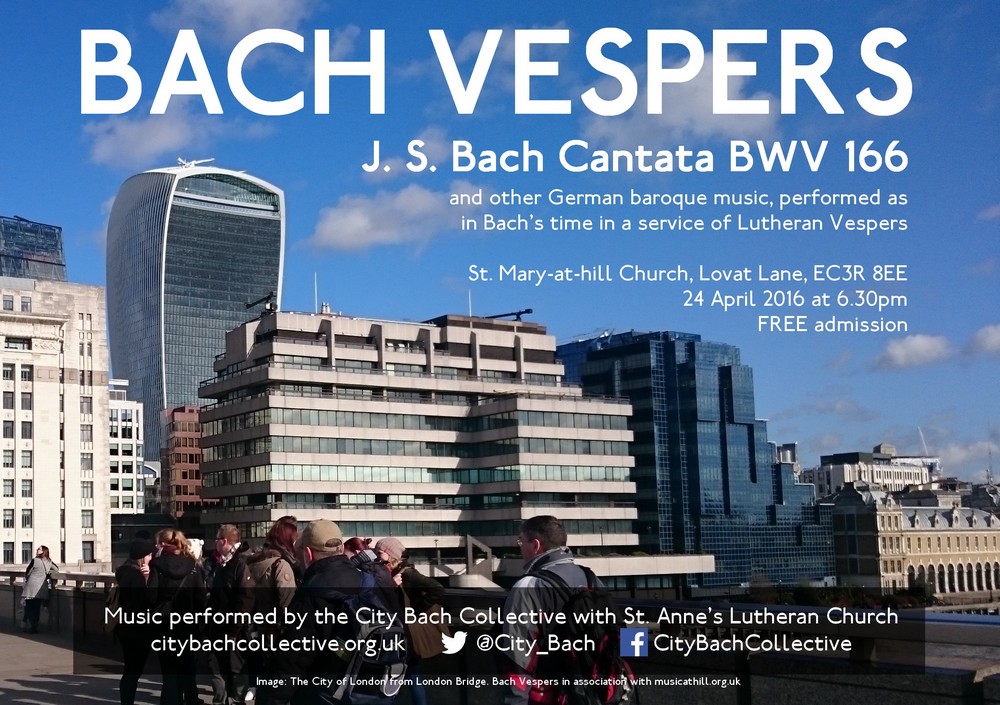
Bach Vespers, St. Mary-at-hill, 24 April 2016

24aprilflyer_SMALL

We are very pleased that St. Anne’s Lutheran Church have invited us to return to perform the music at Bach Vespers on 24 April. This Sunday, the fourth after Easter, is Cantate Sunday, for which Bach wrote the cantata ‘Wo gehest du hin?’, BWV 166, in Leipzig in 1724.

We plan to perform various other works by Buxtehude and Schütz in addition at appropriate junctures during the service of Lutheran Vespers, including Schütz’s setting of the Creed from the Kleine Geistliche Konzerte SWV 303. (There’s a Facebook event listing here, as well as Bachtrack and Concert-Diary listings if you have a preferred window by which to view the event.)

The Rev. Andy Roland will preach a sermon prior to the cantata and the City Bach Collective will be directed by the leader Hazel Brooks. This service of Lutheran Vespers is free to attend at St. Mary-at-hill, Lovat Lane, EC3R 8EE at 6.30pm.

Bach Magnificat, Sonoro Choir and Ensemble, St. Martin in the Fields

Photo: Nick Rutter via Twitter

Anyone who has ever walked through Trafalgar Square has at least seen the church of St. Martin-in-the-Fields. Not only an attractive, imposing church at the top of the East side of the square, this well-maintained and run institution is popular for its sizeable crypt cafe as well as renovated meeting spaces.

Above all both those familiar with London and tourists alike are drawn to it as a beautiful baroque church, both inside and out. As a working church, the interior is in constant use. Most regularly, this involves concert-giving. The music often features familiar music from the period (concerts are often advertised as ‘candle-lit’ to capitalise on the atmosphere).

This was the nature of the programme last night as the Sonoro Choir and (period instrument) Baroque Ensemble gave a concert of music by Vivaldi, Bach and – on his birthday, no less – Handel. I had gone, principally, to see some colleagues perform the Bach Magnificat BWV 243, the brisk and beautiful canticle setting. This was rendered with great vitality but one would have expected nothing less in a concert that brought an admirable heft to Zadok the Priest and some proper musical shape to Vivaldi’s much-loved Gloria.

Most interesting though was to see the early flowering of this new ensemble. Conductor Neil Ferris suggests that their ‘essentially European sound has been realised by allowing our singers to be free to use all of their voice… The choir will perform Romantic through to contemporary repertoire, as well as having a natural affinity with the Baroque’. This intent was validated with a spirited a capella encore, Charles Wood’s ‘Hail Gladdening Light’, a piece written a good 150 years after much of what had gone before. A full church seemed to like the music very much.

Oxford Baroque, German Motets, Kings Place

ox_baroqueIt was lovely to discover that our friends at Oxford Baroque were coming to London’s King’s Place to perform in the Baroque Unwrapped series. The group’s director David Lee had drawn together a programme called ‘A New Song: Bach and the German motet‘, featuring Singet dem Herrn, Jesu meine Freude and Lobet den Herrn (BWVs 225, 227 & 230) preceded by a number of other works by Walther, Schütz, Gabrieli, Hassler, Erbach, Roth, Calvisius & Jacob Handl.

Simply staged, the concert was given with the eight singers arranged either side of a continuo group (organ, violone and viola da gamba), with a certain amount of re-positioning between pieces. This antiphonal attention paid great dividends. The performance felt properly discursive not least as the group, operating without a dedicated conductor, often had their heads out of their scores to look (and smile!) at one another. The to-and-fro of the music was carried on a clear sense of style. I loved the clarity and finesse of the singing, particularly noteworthy in music high in the voice. Sopranos Emily Atkinson & Rachel Ambrose Evans are particularly praiseworthy here for keeping their sound woven into the top of the ensemble – as well as the stamina needed to singing at a calibrated dynamic in altitude throughout.

Such clear, sensibly-paced singing from everyone inevitably made for a true ensemble. This was most impressive in Singet, taken at terrific speed to begin with, but one that made lovely sense of the central aria and chorale. But the greatest benefit was in the second-half performance of Jesu, meine Freude. This occluded, intense performance took the group down to the basic five singers with the super decision to double the alto with Gavin Kibble’s gamba in the delicate Gute Nacht, O Wesen quartet. Beautiful.

Of the other works, JL Bach‘s Das ist meine Freude made the greatest impression with its detailed rhetoric (there’s a lot of effective space in this work). A terrific evening of re-visiting lively re-interpretation of old friends and discovering new, pertinent cousins (literally, in Johann Ludwig’s case!).